
Partitions
Partitions in AnalyticsCreator are used to divide large fact or dimension tables into logical slices for improved performance, faster refresh operations, and better manageability in OLAP-based data marts.
Function
The partitioning mechanism allows you to specify time-based or logic-based slices using SQL expressions. During deployment, AnalyticsCreator automatically generates the required partition objects for both Multidimensional and Tabular models.
- Improves performance by reducing scan ranges
- Enables incremental refresh strategies
- Supports parallel processing during cube builds
- Aligns with semantic model refresh patterns
Access
Partitions are managed under the Data Mart → Partitions module. The interface provides a list view and a detailed edit view for creating or modifying partition definitions.
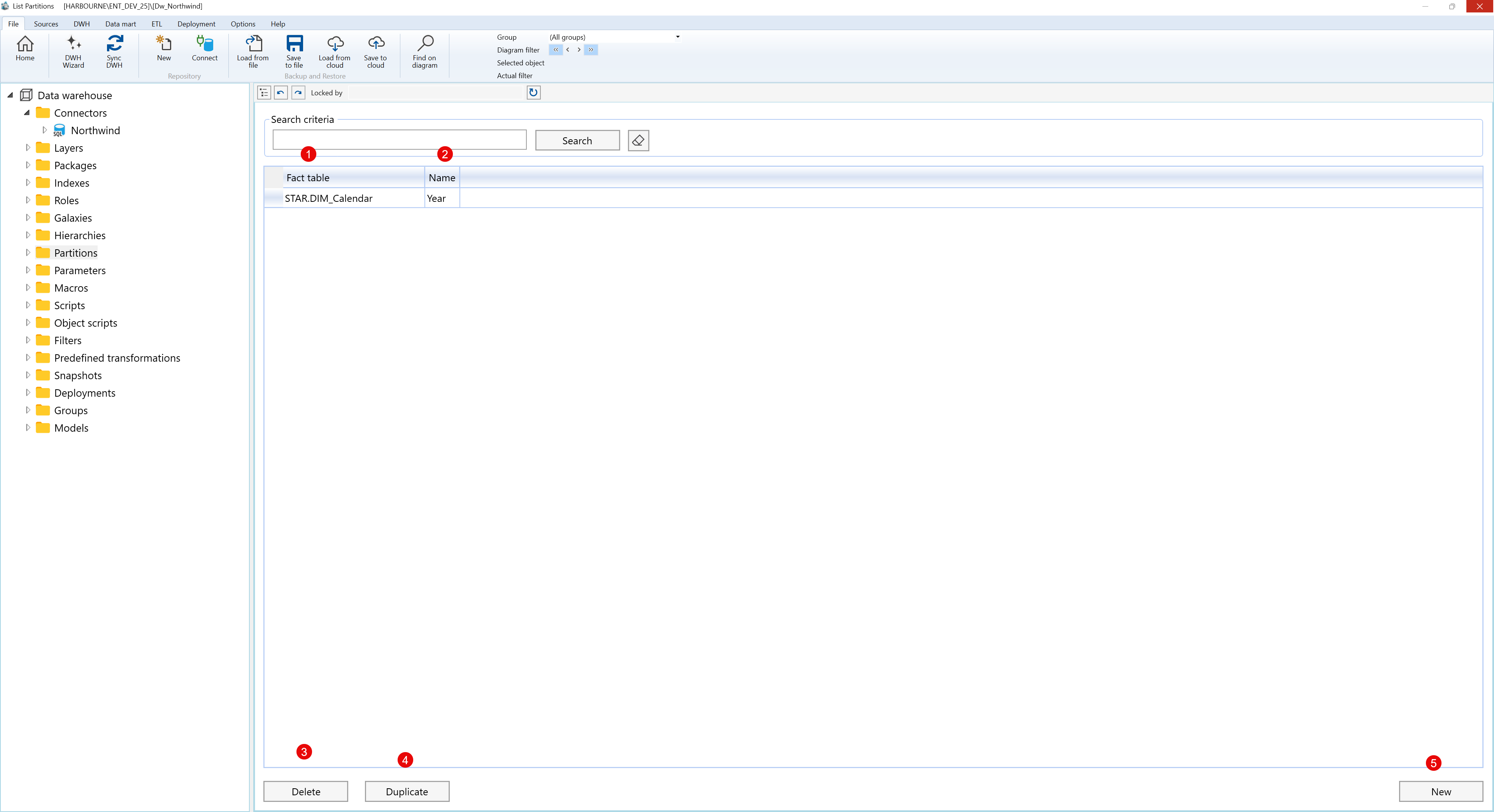
Properties – List View
| ID | Property | Description |
|---|---|---|
| 1 | Search by fact table | Filters the list by the target fact table |
| 2 | Search by partition name | Filters by partition identifier (e.g., Year, Month) |
| 3 | Delete | Removes the selected partition from metadata |
| 4 | Duplicate | Creates a copy of an existing partition definition |
| 5 | New Partition | Opens the editor to define a new partition |
Screenshot: Partitions List View
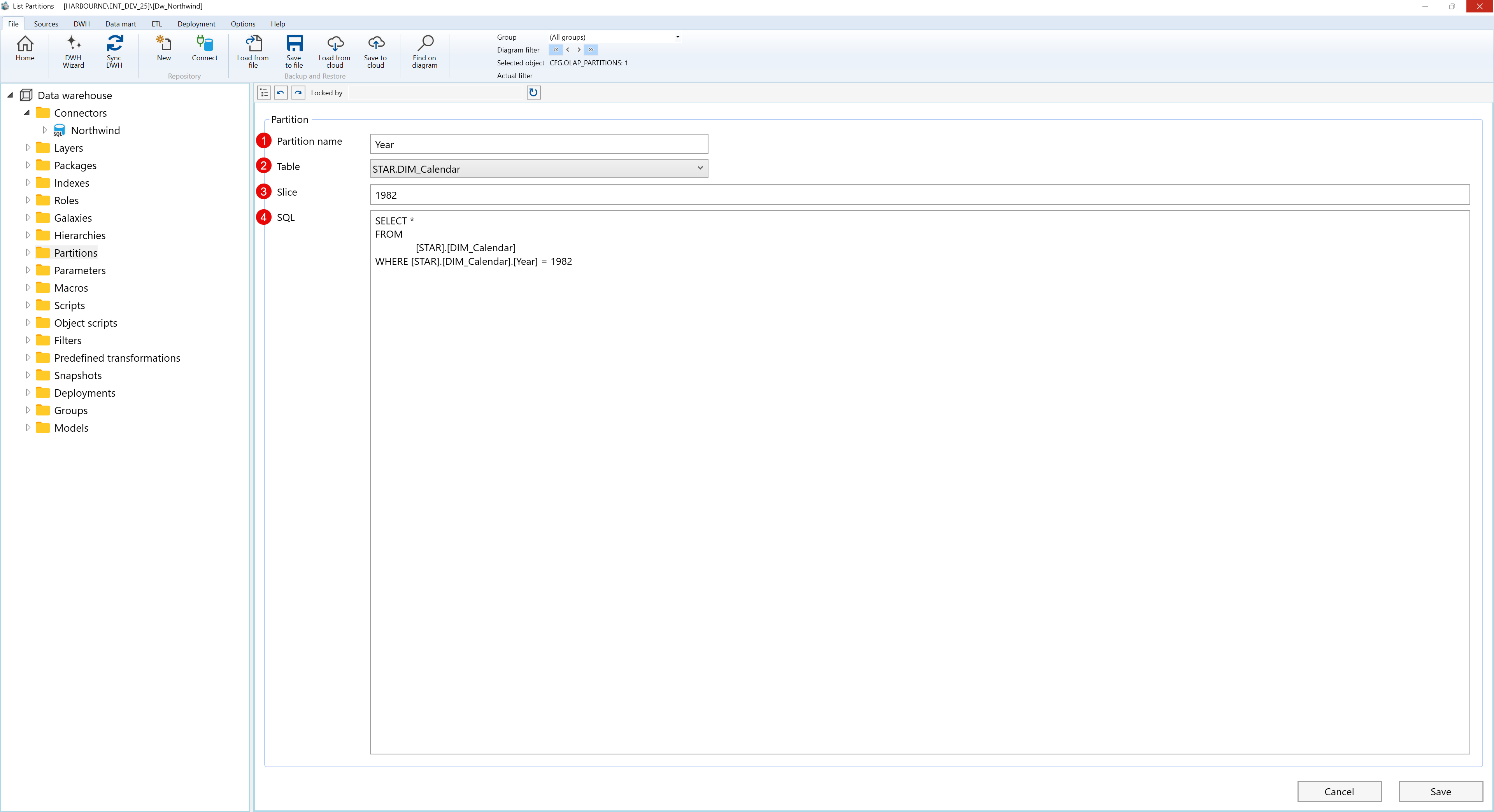
Properties – Edit View
| ID | Property | Description |
|---|---|---|
| 1 | Partition Name | User-defined label for the slice (e.g., “Year 1982”) |
| 2 | Table | Fact or dimension table to be partitioned |
| 3 | Slice | Key or descriptive value representing the partition slice (e.g., “1982”) |
| 4 | SQL | SQL expression defining the data slice (e.g., WHERE [Year] = 1982) |
| 5 | Cancel | Discards changes made in the editor |
| 6 | Save | Commits the partition definition to metadata |
Screenshot: Partition Edit View
Behavior
- Partitions are applied only in the Data Mart layer.
- Multidimensional models: only fact tables can be partitioned.
- Tabular models: fact and dimension tables can both be partitioned.
- Partition SQL is regenerated during deployment based on metadata.
- Partition slicing supports incremental refresh and parallel processing.
