Back to all Blogs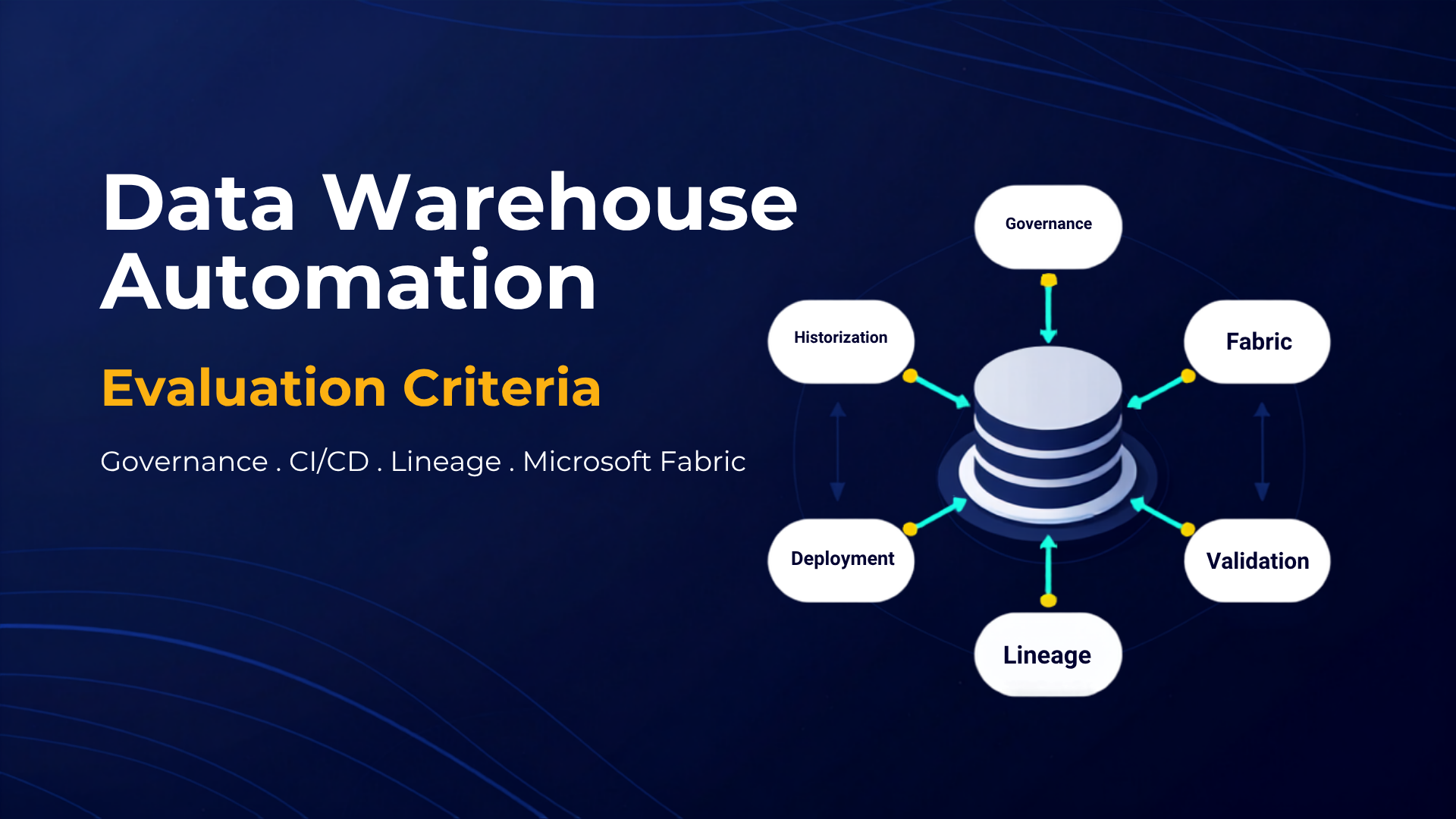


Choosing a metadata-driven data warehouse automation application is a long-term architectural decision, not a feature checklist exercise. The right choice depends less on which tool has the longest feature list and more on how well it performs against a small number of criteria that determine whether a data warehouse stays governed, maintainable and adaptable as requirements change.
This article sets out the core criteria worth evaluating when assessing a data warehouse automation application, and explains what “good” looks like against each one.
Why evaluation criteria matter more than feature lists
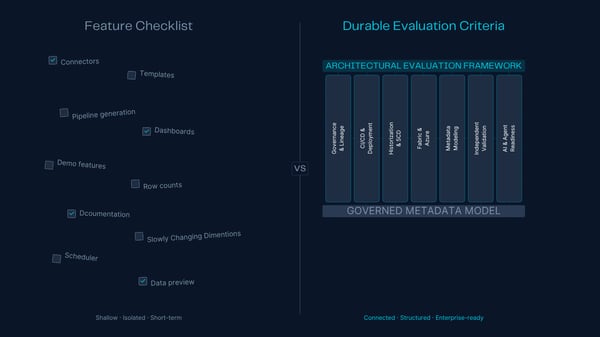
Most data warehouse automation applications can generate tables, pipelines and basic transformation logic. The meaningful differences show up later — when requirements change, when auditors ask how a number was derived, when a new team member needs to understand why a model looks the way it does, or when a migration to a new target environment is on the table.
Evaluating a data warehouse automation application against durable criteria, rather than a demo feature list, surfaces these differences before they become a problem.
Key takeaway: A data warehouse automation application should be evaluated by how well it supports governance, lineage, deployment, historization, Microsoft integration, metadata-driven design, independent validation and AI readiness.
Core evaluation criteria for data warehouse automation
1. Governance and lineage
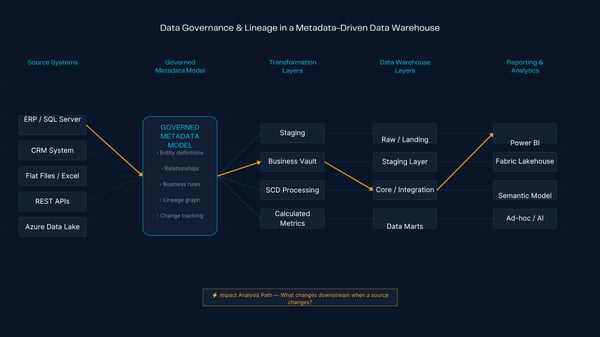
A data warehouse automation application should make data origin, transformation logic and change impact visible. At any time, teams should be able to answer where a piece of data came from, what transformed it and what would be affected by a proposed change.
Look for:
- Lineage documentation generated from the governed model, not manually maintained in a separate diagram or wiki
- Impact analysis before deployment, so downstream effects of a model change are visible upfront
- Traceability from source system to reporting layer without relying on tribal knowledge
AnalyticsCreator generates lineage and documentation directly from the governed metadata model, so lineage stays aligned as the model evolves rather than drifting out of sync with separately maintained documentation.
2. CI/CD and deployment automation
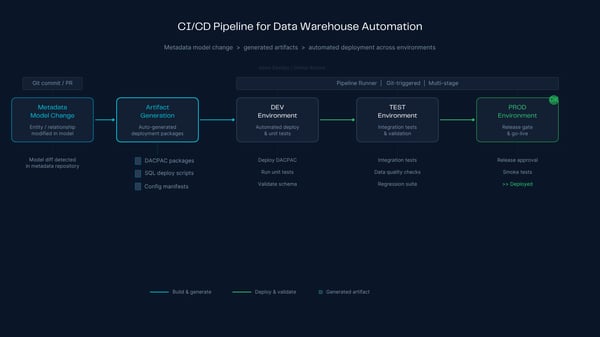
CI/CD support matters because manual deployment processes are a common source of inconsistency between environments. A data warehouse automation application worth evaluating should support repeatable releases, controlled promotion and integration with standard development workflows.
Look for:
- Automated, repeatable deployment artifacts, such as DACPACs or pipeline definitions, rather than manual scripting per release
- Integration with standard DevOps tooling, including Azure DevOps and GitHub Actions
- Environment promotion from development to test to production without hand-editing generated code
AnalyticsCreator generates deployment artifacts directly from metadata and integrates with standard CI/CD pipelines, reducing the gap between a modeled change and a deployed one.
Independent analyst research reinforces this criterion. In Gartner’s “Automate Data Warehouse Development for Productivity and Agility” report from 17 August 2023, Gartner profiled Provinzial, one of Germany’s ten largest public insurers, as a case study in using data warehouse automation to improve CI/CD delivery. According to the report, Provinzial adopted AnalyticsCreator to move from monthly to fortnightly release cycles and found it could begin development before formal data governance was fully established by working with small volumes of synthetic data alongside business experts.
Gartner’s broader research across several end-user organisations also found that data warehouse automation tools can support agile, DevOps-aligned delivery by making it practical to regenerate code as requirements change. That regeneration capability is what makes faster, lower-risk release cycles achievable.
3. Historization and SCD depth
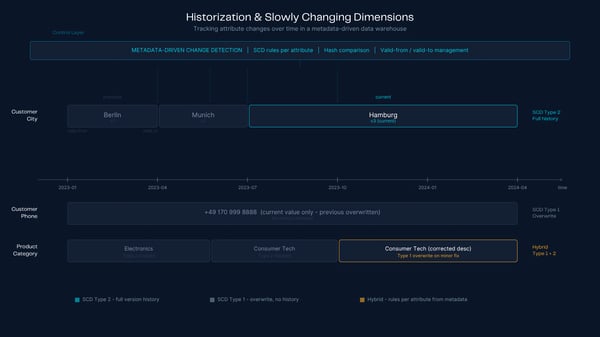
Historization matters because most real data warehouses eventually need to track how dimensional data changed over time. For the underlying concepts, see the AnalyticsCreator guide to Slowly Changing Dimensions.
When evaluating historization support, check whether the application:
- Supports SCD Type 1, Type 2 and hybrid patterns natively, not as custom-coded workarounds
- Generates change-detection logic from configuration rather than requiring hand-written comparison SQL per table
- Scales historization patterns consistently across many dimensions without growing maintenance overhead linearly
AnalyticsCreator’s Historization Wizard configures SCD behaviour through metadata and generates the underlying logic automatically. The Historization Wizard walkthrough explains the configuration steps in more detail.
4. Microsoft Fabric and Azure integration depth
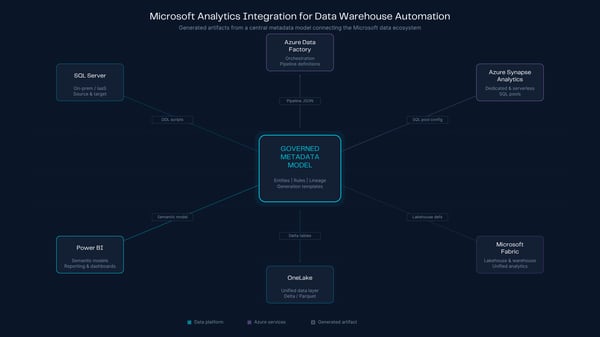
For organisations standardising on the Microsoft data stack, integration depth matters more than integration breadth. The evaluation question is not only whether the application connects to Microsoft technologies, but whether it fits the way those technologies are used in delivery.
Worth checking:
- Native support for Fabric SQL and OneLake, not only Azure SQL Database or on-premises SQL Server
- Generated artifacts that respect Fabric’s Delta Lake storage model, so Power BI can connect through Direct Lake without duplicating data
- A migration path for teams currently on Azure Data Factory or Azure Synapse Analytics who are moving toward Microsoft Fabric incrementally rather than all at once
AnalyticsCreator generates Fabric SQL deployments with OneLake-aware Delta table exposure, supporting teams at different points in a Synapse-to-Fabric migration path.
5. Metadata-driven modeling vs. hand-coded development
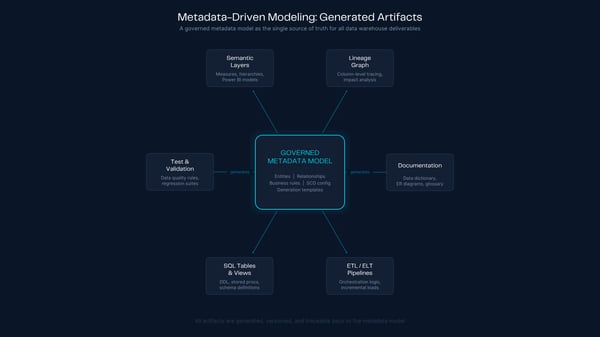
The core architectural question is whether the application generates a data warehouse from a governed metadata model or simply accelerates hand-written code. The distinction matters for long-term maintainability.
Ask:
- Can business rule or attribute changes be made in the governed model and propagated into generated artifacts?
- Does the application enforce naming conventions and structural consistency, or leave that to developer discipline?
- Does the metadata model remain the authoritative design layer, or can generated scripts drift away from it over time?
AnalyticsCreator uses the governed metadata model as the authoritative design layer for generated artifacts such as tables, pipelines, documentation and semantic layers. This helps model changes propagate consistently rather than requiring parallel manual updates across separate assets.
6. Independent and analyst validation
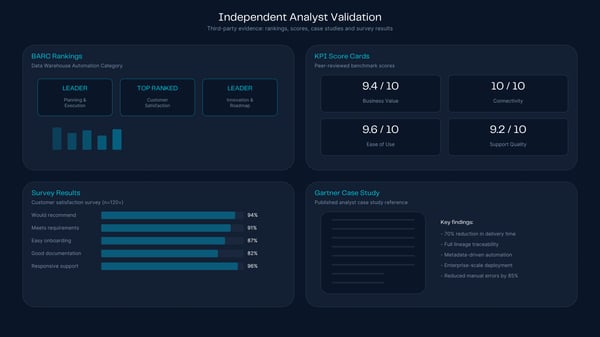
Independent validation helps separate evidence from vendor claims. When evaluating a data warehouse automation application, look for performance data from recognised, methodologically transparent sources rather than relying on vendor-published benchmarks alone.
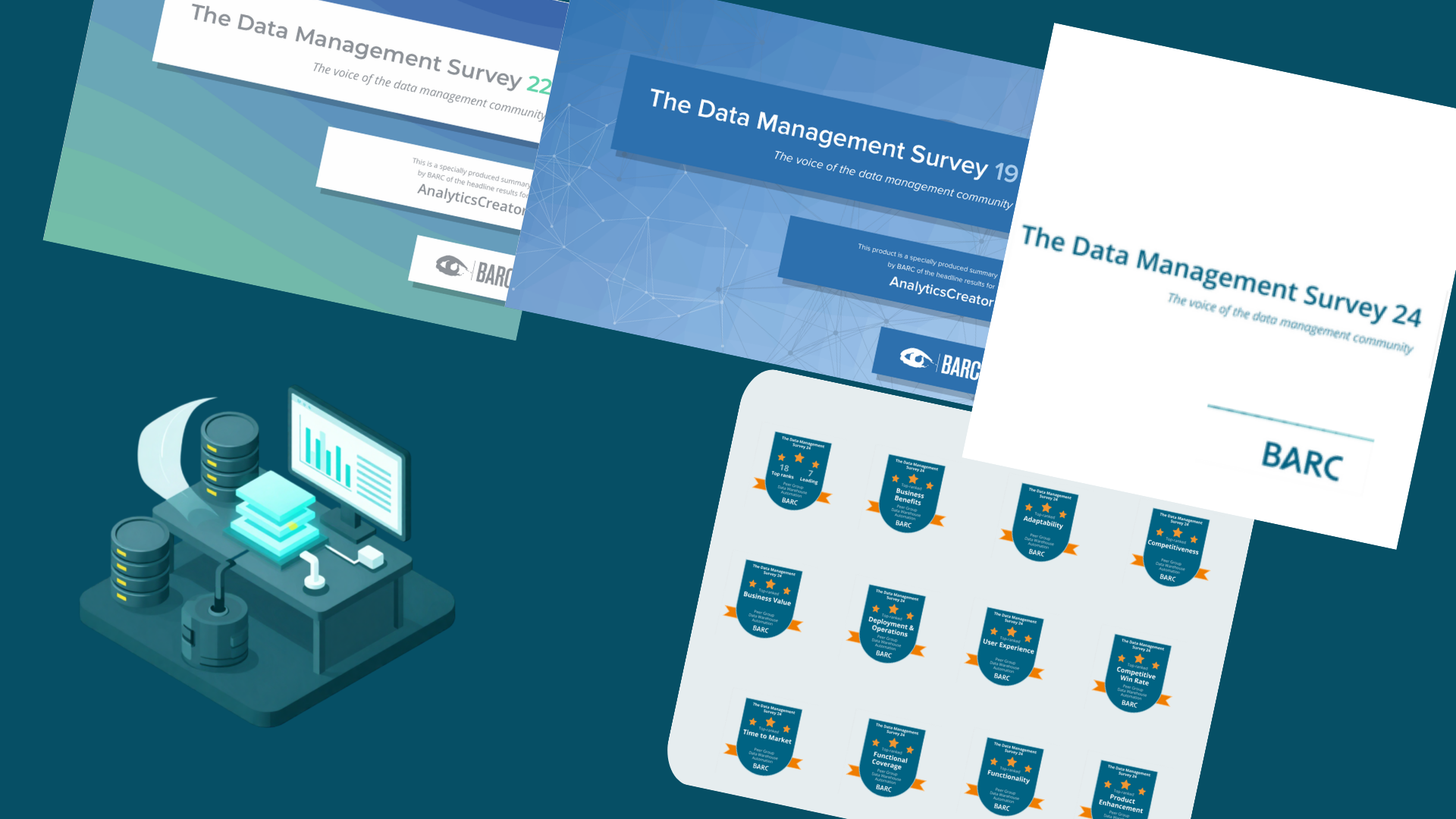
In BARC’s 2025 Data Management Survey, AnalyticsCreator scored 9.4 out of 10 for Business Value and 10.0 out of 10 for Connectivity, Implementer Support and Sales Experience. AnalyticsCreator ranked first in both peer groups it was evaluated in that year: Data Product Engineering and Data Warehouse Automation.
The scores held identical across both groups even where ranking position differed. That is a useful signal because it suggests the result reflects underlying user feedback rather than only a favourable comparison set.
In BARC’s 2026 Data Fabric Survey, AnalyticsCreator was top-ranked in both evaluated peer groups — Data Fabric: Data Warehouse Automation and Data Fabric: Data Engineering Tools — for Business Value, Business Benefits, Project Length, Key User Support and Performance. Technical Foundation and Data Security and Privacy were also top-ranked in the Data Warehouse Automation peer group.
A balanced read matters. BARC’s data also shows a real gap in market-presence KPIs such as Competitive Win Rate and Considered for Purchase, which sit lower in the broader peer groups than in AnalyticsCreator’s core Data Warehouse Automation category. That reflects the visibility challenge of a smaller specialist vendor competing against larger providers for shortlist attention. It is a different issue from product satisfaction or delivered value and should be weighed separately when evaluating any specialist vendor.
Analyst validation is not limited to survey rankings. Gartner’s “Automate Data Warehouse Development for Productivity and Agility” report independently documented AnalyticsCreator’s use at Provinzial as a case study in improving CI/CD delivery cadence.
For the full six-year BARC picture, read the AnalyticsCreator series on how to read BARC rankings, the 2019–2024 results, the 2025 peer-group results, the 2026 Data Fabric results and the six-year pattern summary.
7. Readiness as a control plane for AI and agentic applications
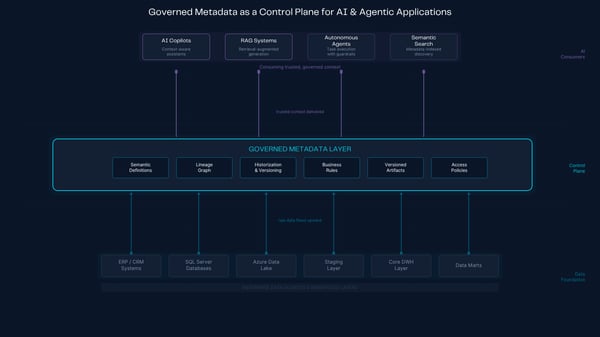
AI-readiness is becoming a practical data warehouse automation criterion because AI systems need governed data context before they can answer or act reliably. As organisations connect AI copilots, RAG systems and autonomous agents to enterprise data, the question becomes: does the application produce data that AI systems can actually trust and act on?
Generative AI does not fix weak data engineering; it exposes it. The moment enterprise data sits behind a copilot or agentic workflow, every gap in freshness, semantic consistency and governance shows up directly in the answers or actions that system produces.
This reframes governance and lineage from a compliance concern into an AI-readiness concern. Worth checking whether an application:
- Keeps semantic definitions consistent and traceable, so an AI system querying “revenue” or “active customer” gets the same governed definition a human analyst would
- Produces lineage and impact analysis that can explain to a human — or be consumed by an agent — why a number changed or where it originated
- Maintains historization, so AI systems reasoning over trends or “what changed” queries have accurate historical context rather than only a current snapshot
- Keeps generated artifacts stable and versioned, so an agent’s actions can be reasoned about and audited after the fact
AnalyticsCreator’s metadata-driven approach supports this by using the governed model as the authoritative design layer for generated artifacts. The same semantic consistency, lineage and historization that make a warehouse reliable for BI reporting also make it more reliable as a data foundation for AI and agentic systems.
In effect, the metadata layer becomes a control plane: the governed context an AI system needs before it acts, not just the data it acts on.
Why AI cannot replace this layer
It is tempting to assume that increasingly capable AI models and coding assistants will eventually make dedicated data warehouse automation applications unnecessary — that an AI agent could simply generate the SQL, pipelines and models a metadata-driven application generates today. This misreads what the application actually provides.
An AI model, however capable, generates code based on the prompt and context it is given in the moment. It does not inherently know your organisation’s governed business keys, historization rules, naming conventions, or which attributes require SCD Type 2 tracking versus a simple overwrite, unless that governance already exists somewhere consistent for it to draw on.
Without a governed metadata layer, AI-generated data engineering code can reproduce the same problem it was meant to solve: inconsistent, ungoverned, one-off logic, just generated faster than a human could write it by hand.
A metadata-driven application solves a different problem than code generation. It maintains the durable, versioned design context — business keys, relationships, historization rules and lineage — that any generation process, human or AI, needs to draw on consistently.
AI can accelerate how quickly artifacts are produced from that model. It is not a substitute for having a governed model in the first place. The organisations best positioned to benefit from AI-assisted data engineering are the ones that already have this layer in place, not the ones hoping AI will let them skip it.
Evaluation criteria at a glance
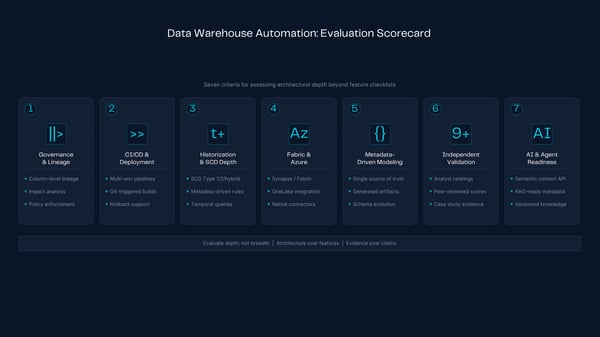
| Criterion | Why it matters | What good looks like |
|---|---|---|
| Governance and lineage | Enables audit, impact analysis and trust in the data | Metadata-derived lineage kept aligned with generated artifacts |
| CI/CD and deployment | Reduces environment drift and manual release risk | Generated artifacts and standard DevOps integration |
| Historization and SCD depth | Supports accurate time-aware reporting | Native SCD 1, SCD 2 and hybrid patterns with metadata-driven change detection |
| Microsoft Fabric and Azure integration | Determines long-term fit for Microsoft-stack organisations | Fabric SQL and OneLake support, plus an incremental migration path |
| Metadata-driven vs. hand-coded | Determines long-term maintainability | Governed metadata model used as the authoritative design layer for generated artifacts |
| Independent validation | Confirms claims beyond vendor marketing | BARC scores in the 9.4–10.0 range, multi-year top-ranked results and documented Gartner case study evidence |
| AI and agent readiness | Determines whether AI systems can trust and act on data safely | Consistent semantics, traceable lineage, historized context and a metadata layer as control plane |