Back to all Blogs


Slowly Changing Dimensions (SCDs) are a core data warehousing technique for tracking how descriptive data changes over time. Originally introduced by Ralph Kimball for dimensional modeling, SCDs help teams preserve historical context instead of only keeping the latest value. They are now used not only for dimensions, but also for broader data historization patterns in staging, persisted staging, and analytical layers.
In this article, we explain what Slowly Changing Dimensions are, why they matter, the main SCD types, and how data warehouse automation can simplify implementation and long-term maintenance.

What Is a Slowly Changing Dimension?
A Slowly Changing Dimension (SCD) is a data warehousing technique used to capture and store historical changes in descriptive attributes over time. Although the term includes the word “slowly,” changes may occur infrequently or frequently. What matters is that the data warehouse can answer what was true at a specific point in time.
- Historical storage: SCDs preserve previous attribute values instead of simply overwriting them.
- Change tracking: They track how attributes such as address, customer status, product category, supplier status, or organizational assignment evolve.
- Analytical context: They enable questions like “What was true at that time?” rather than only “What is true today?”

Importantly, SCD changes do not have to be slow. Modern data automation approaches can support historization when attributes change occasionally, frequently, or unpredictably. The key requirement is that changes are captured consistently and can be queried reliably.
Implementing SCDs manually, without data warehouse automation, is possible but often complex and time-consuming. It requires careful ETL or ELT development, management of surrogate keys, accurate handling of validity dates, and clear rules for detecting changes. Manual implementation can become slow, expensive, and prone to inconsistency across projects.
Data warehouse automation can simplify and accelerate SCD implementation by applying repeatable patterns, generated logic, and metadata-driven configuration. This reduces implementation risk while improving consistency and speed.
Formal Definition of Slowly Changing Dimensions
- Architecture concept: A method for storing historical attribute values over long periods.
- Attribute change tracking: A technique for capturing changes in dimension attributes such as customer details, product features, supplier information, or organizational structures.
- Data modeling technique: A pattern that stores multiple record versions with validity information, enabling reconstruction of historical states.
Common Types of Slowly Changing Dimensions
Different SCD types handle change in different ways. The right choice depends on whether the historical value matters for reporting, auditability, or business analysis.
- SCD Type 0: The original value is retained and changes are ignored. This is useful for attributes that should not change after creation.
- SCD Type 1: The old value is overwritten with the new value. This is useful for corrections or attributes where only the latest value matters.
- SCD Type 2: A new row is created for each meaningful change, while the previous row is closed with validity information. This is the most common approach when historical accuracy matters.
- SCD Type 3: Limited history is stored in additional columns, such as previous and current value. This is useful only when a small amount of history is required.
- Hybrid SCD: A combination of SCD types, often used when some attributes require full history and others only require the latest value.
For a more practical walkthrough of SCD configuration in AnalyticsCreator, see how the Historization Wizard supports SCD historization.
Example: Slowly Changing Dimension for Customer Address
A classic example of a Slowly Changing Dimension is the history of a customer's address. A customer may move several times, and your analytics may need to answer:
- “Where did the customer live when this sale occurred?”
- “How did sales in a region evolve over time?”
- “Which customer segment applied when the transaction was recorded?”
To model this as an SCD Type 2 dimension, you typically follow these steps:
- Create a customer dimension table with:
- CustomerID or another business key
- CustomerName
- CustomerAddress
- ValidFrom / ValidTo
- IsCurrent flag
- Add a surrogate key so each version of the customer record is unique.
- Create a fact table such as Sales, which references the surrogate key and contains measures like SalesAmount.
- Insert a new row every time a historized attribute changes, updating the ValidTo value of the previous record.
This ensures that analytical queries can return the correct historical address or customer attribute for each transaction.
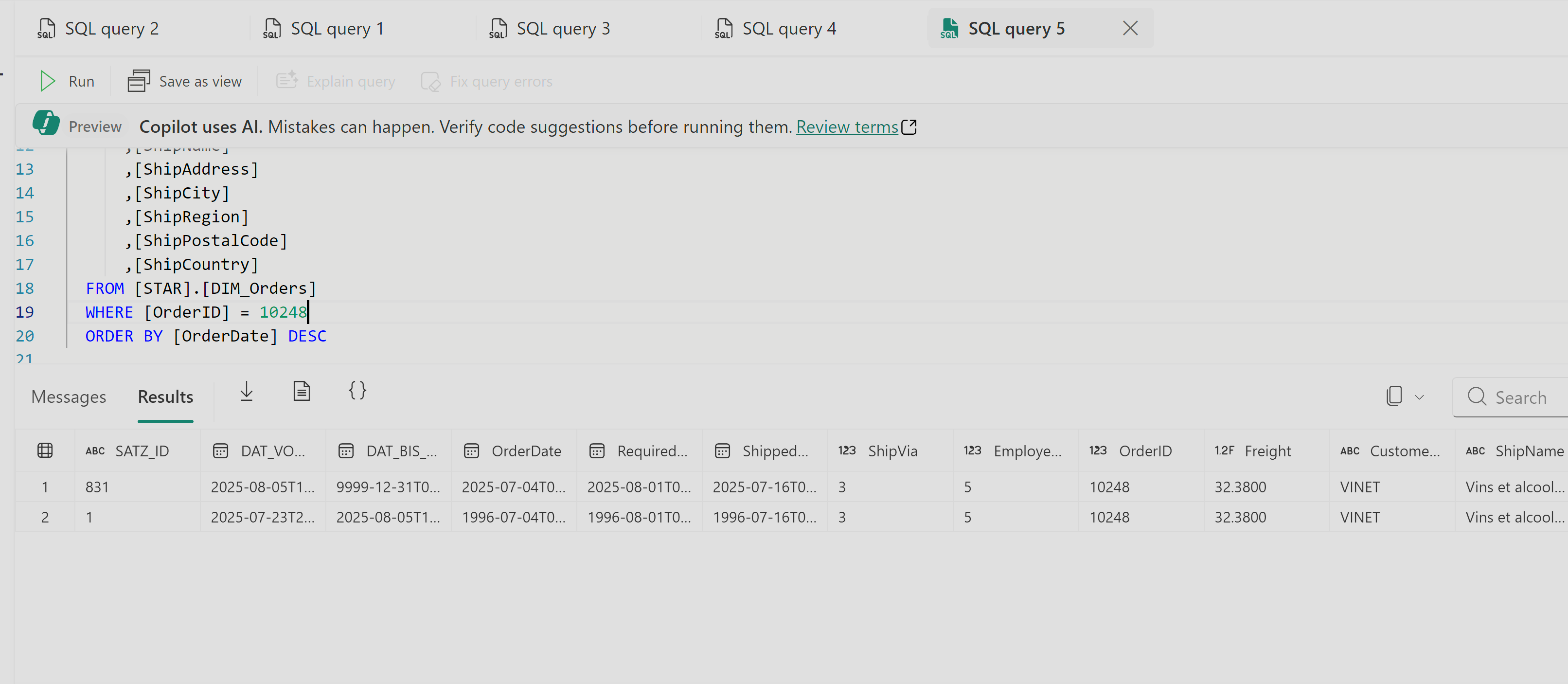
The table below shows what this looks like once a change occurs. Suppose customer Jane Doe moves from Manchester to Bristol on 15 March 2025:
| SurrogateKey | CustomerID | CustomerAddress | ValidFrom | ValidTo | IsCurrent |
|---|---|---|---|---|---|
| 1001 | C-204 | Manchester | 2022-01-10 | 2025-03-15 | 0 |
| 1002 | C-204 | Bristol | 2025-03-15 | NULL | 1 |
The first row is closed with a ValidTo date the moment the address changes; the second row opens with the new address and an open-ended ValidTo (or a high-date placeholder such as 9999-12-31). Any sale linked to surrogate key 1001 will always report against Manchester, regardless of when the report is run.
Example SQL Logic for SCD Type 2
The following simplified, dialect-agnostic SQL illustrates the merge logic behind the example above:
-- Step 1: Close the current record if the address has changed
UPDATE CustomerDim
SET ValidTo = GETDATE(), IsCurrent = 0
WHERE CustomerID = 'C-204'
  AND IsCurrent = 1
  AND CustomerAddress <> 'Bristol';

-- Step 2: Insert the new version of the record
INSERT INTO CustomerDim (CustomerID, CustomerAddress, ValidFrom, ValidTo, IsCurrent)
SELECT 'C-204', 'Bristol', GETDATE(), NULL, 1
WHERE NOT EXISTS (
  SELECT 1 FROM CustomerDim
  WHERE CustomerID = 'C-204' AND CustomerAddress = 'Bristol' AND IsCurrent = 1
);
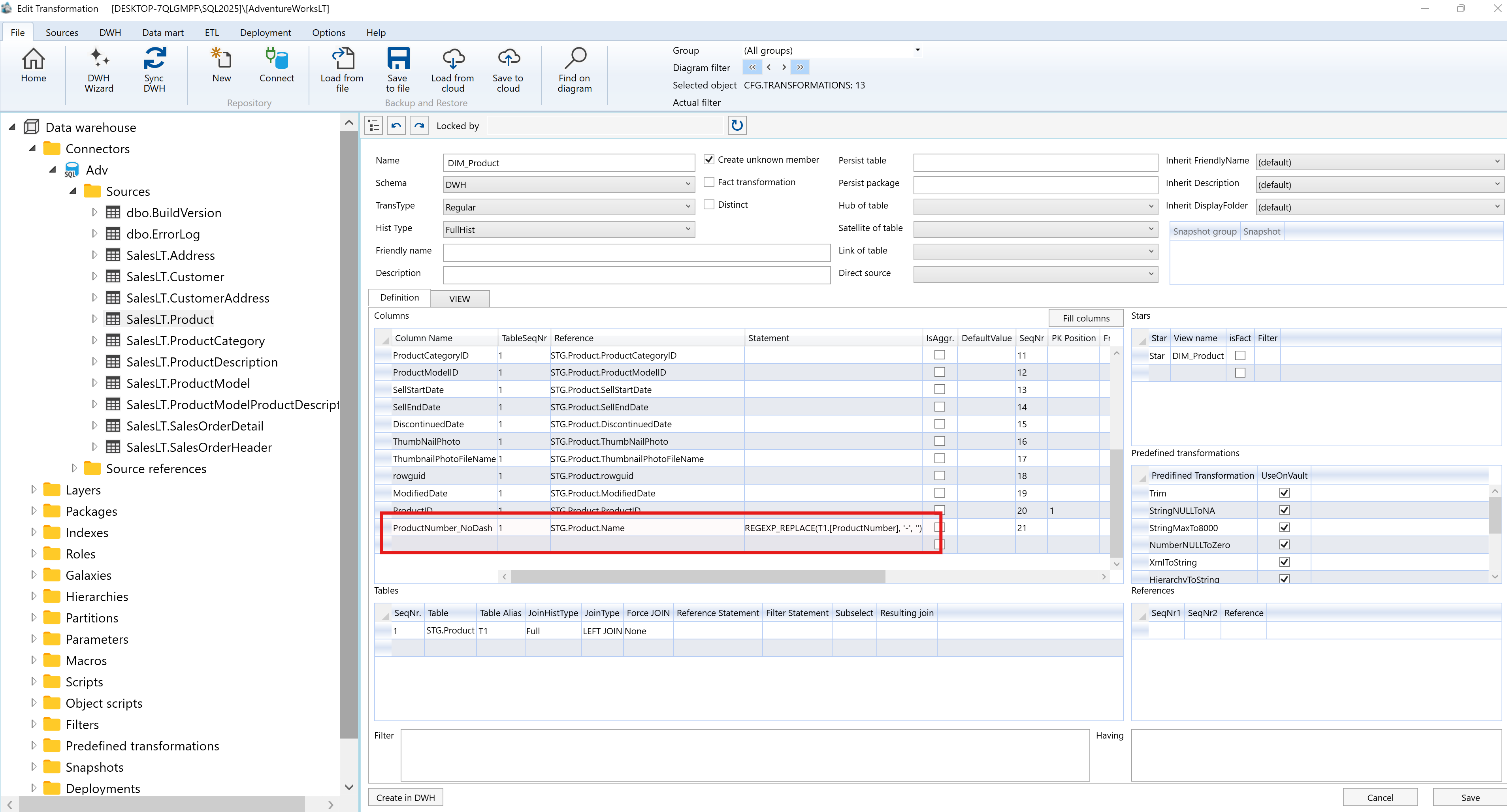
In AnalyticsCreator, this change-detection and insert/update logic is generated automatically from metadata rather than hand-written — see how the Historization Wizard handles this step.
Benefits of Slowly Changing Dimensions
- Accurate historical analysis: Supports time-correct reporting based on historical attribute values.
- Better auditability: Makes it easier to understand how important descriptive attributes changed over time.
- Less reprocessing: Reduces the need to rebuild history retroactively when source values change.
- Improved analytical context: Enables analysis of how changes, such as customer segments, product categories, or organizational assignments, affected KPIs over time.
- Stronger governance: Provides a clearer structure for tracing historical changes in dimensional models.
Challenges of Slowly Changing Dimensions
- Manual maintenance effort: Without automation, SCDs require significant SQL, ETL, or ELT work.
- Complex logic: Handling SCD Type 1, SCD Type 2, SCD Type 3, and hybrid patterns requires modelling expertise.
- More complex queries: Queries involving validity dates, current flags, and surrogate keys can be harder to write and optimize.
- Storage overhead: Multiple historical versions increase data volume, especially for frequently changing attributes.
- Change detection: Teams need clear rules for deciding which attribute changes should create a new historical version.

Despite these challenges, SCDs remain essential for regulatory, analytical, and operational use cases. Their ability to preserve a trustworthy history of changes makes them valuable for organizations that rely on accurate historical insight.
How Data Warehouse Automation Simplifies SCD Implementation
Metadata-driven data warehouse automation can reduce the manual work required to implement SCD logic. Instead of writing each historization pattern by hand, teams can define the relevant metadata, business keys, historized attributes, and SCD behavior, then generate the required artifacts for the selected environment.
Tools like AnalyticsCreator help teams configure and generate SCD structures and historization logic as part of a broader metadata-driven modelling workflow.
Key advantages include:
- Repeatable SCD patterns: Standardized handling for tables, keys, validity fields, current flags, and history logic.
- Lower risk of errors: Metadata-driven configuration reduces the chance of inconsistent manual implementation.
- Faster releases: Changing business rules or adding attributes can be quicker when the logic is generated from a governed model.
- Consistent historization: Uniform implementation across dimensions, layers, and projects.
- Better change transparency: Clearer metadata and lineage help teams understand the impact of model changes.
For Microsoft-oriented teams, SCD Type 2 historization is especially relevant in warehouse and Fabric scenarios. Learn more about how AnalyticsCreator supports SCD Type 2 historization in Microsoft Fabric.
By adopting automation, organizations can reduce complexity and improve efficiency, freeing data teams to focus on modelling, governance, and insights instead of repetitive technical overhead.