Back to all Blogs
Why Metadata Should Be the Single Source of Truth in Microsoft Data Warehouses



Metadata is the backbone of modern Microsoft data warehouses. By using it as the single source of truth, teams can automate modeling, testing, deployment, and auditing—delivering faster with better governance across SQL Server, Synapse, and Microsoft Fabric.
Why metadata matters in modern DWH environments
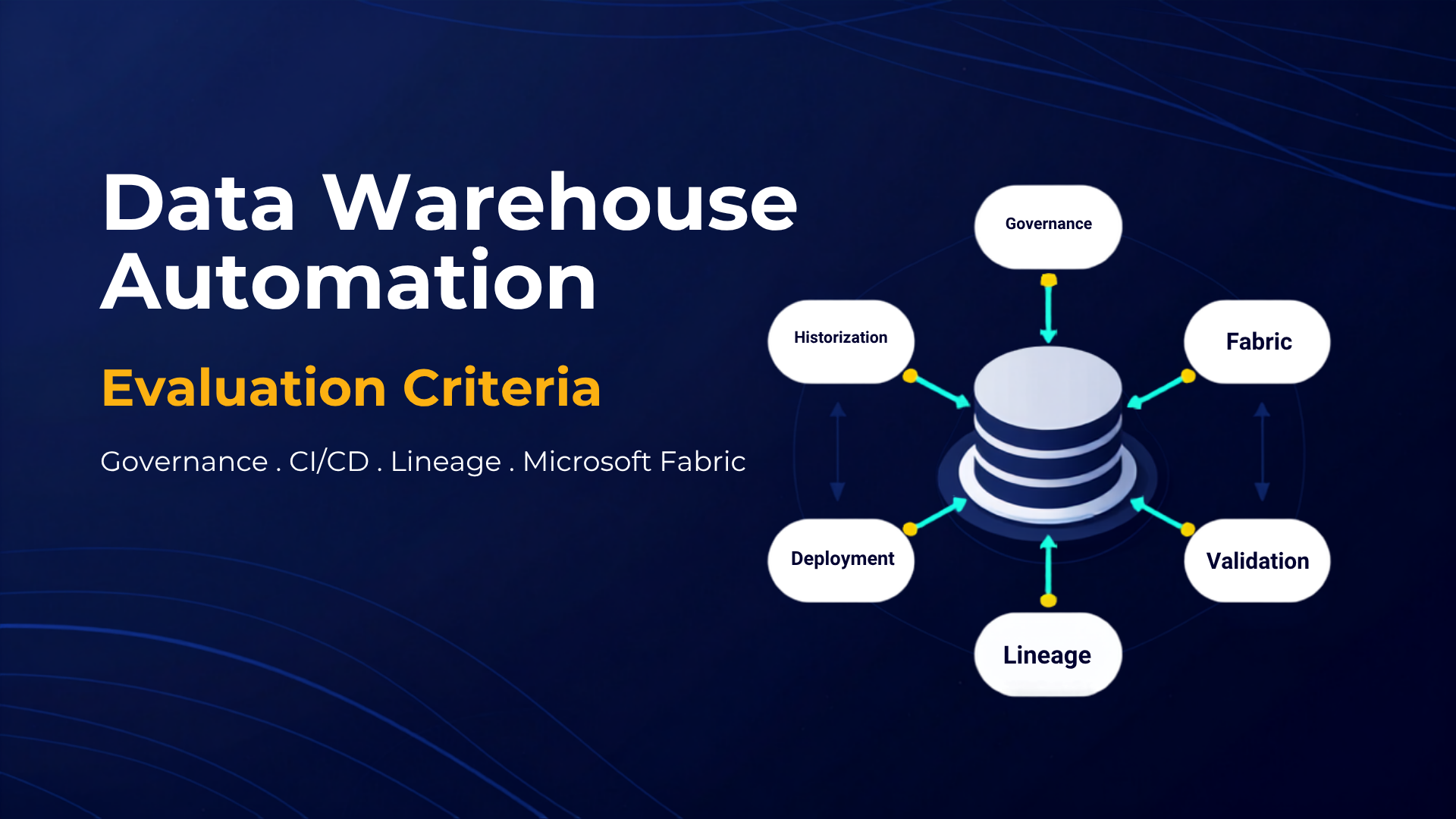
Many Microsoft-based data warehouses still rely on scattered SQL scripts, ad hoc documentation, and inconsistent standards. This creates rework, governance gaps, and model drift over time. Centralizing all definitions—table structures, transformations, historization logic—into a metadata model allows teams to automate, govern, and scale with confidence.
How metadata powers automated testing and audits
When logic lives in metadata—not in scripts—teams can automatically generate code, tests, lineage documentation, and CI/CD pipelines. This makes regression testing, compliance validation, and cross-impact analysis repeatable and auditable. AnalyticsCreator enables this by turning metadata into full pipelines and documentation, drastically reducing risk and manual work.
Making metadata the authoritative source of truth
Shifting to a metadata-first model requires both process and cultural change. Metadata needs to be version-controlled, peer-reviewed, and tightly integrated with CI/CD tools. With this approach, every change—whether to a transformation or a column—is traceable, auditable, and testable. It simplifies deployment, incident response, and knowledge transfer across teams.
The result: automation, governance, and auditability
With tools like AnalyticsCreator, Microsoft data teams can adopt this model end-to-end. Metadata becomes the living blueprint for dimensional modeling, SCD tracking, pipeline generation, and semantic layer deployment. Whether building on SQL Server, Synapse, or Fabric, metadata becomes the engine of speed and control.
Explore how metadata-driven development accelerates your data warehouse → Book a demo
Frequently Asked Questions
What does it mean to treat metadata as the single source of truth?
It means all logic—structures, rules, and transformations—is stored in metadata and used to drive automation and governance.
Why is this important for Microsoft-based data teams?
Because metadata-based automation reduces manual scripting, enables CI/CD, and ensures consistent deployments across SQL Server, Synapse, and Fabric.
What can be stored as metadata?
Modeling logic, transformation steps, historization rules, test cases, pipeline orchestration, and even documentation.
How does metadata improve testing and audits?
Metadata enables automated test generation, lineage visualization, and cross-impact analysis all fully traceable and version-controlled.
What tools support metadata-first development?
AnalyticsCreator is a leading platform that uses metadata to drive full DWH automation for Microsoft environments.
Does this approach work with CI/CD and Git?
Yes. Metadata can be versioned, branched, and deployed via DevOps pipelines just like source code.
What’s the business benefit of metadata-driven DWH?
Faster delivery, lower compliance risk, higher data quality, and better collaboration across teams.
Is metadata useful for audit and governance?
Absolutely. Every change is logged, reviewable, and testable—helping meet governance, lineage, and compliance requirements.