Back to all Blogs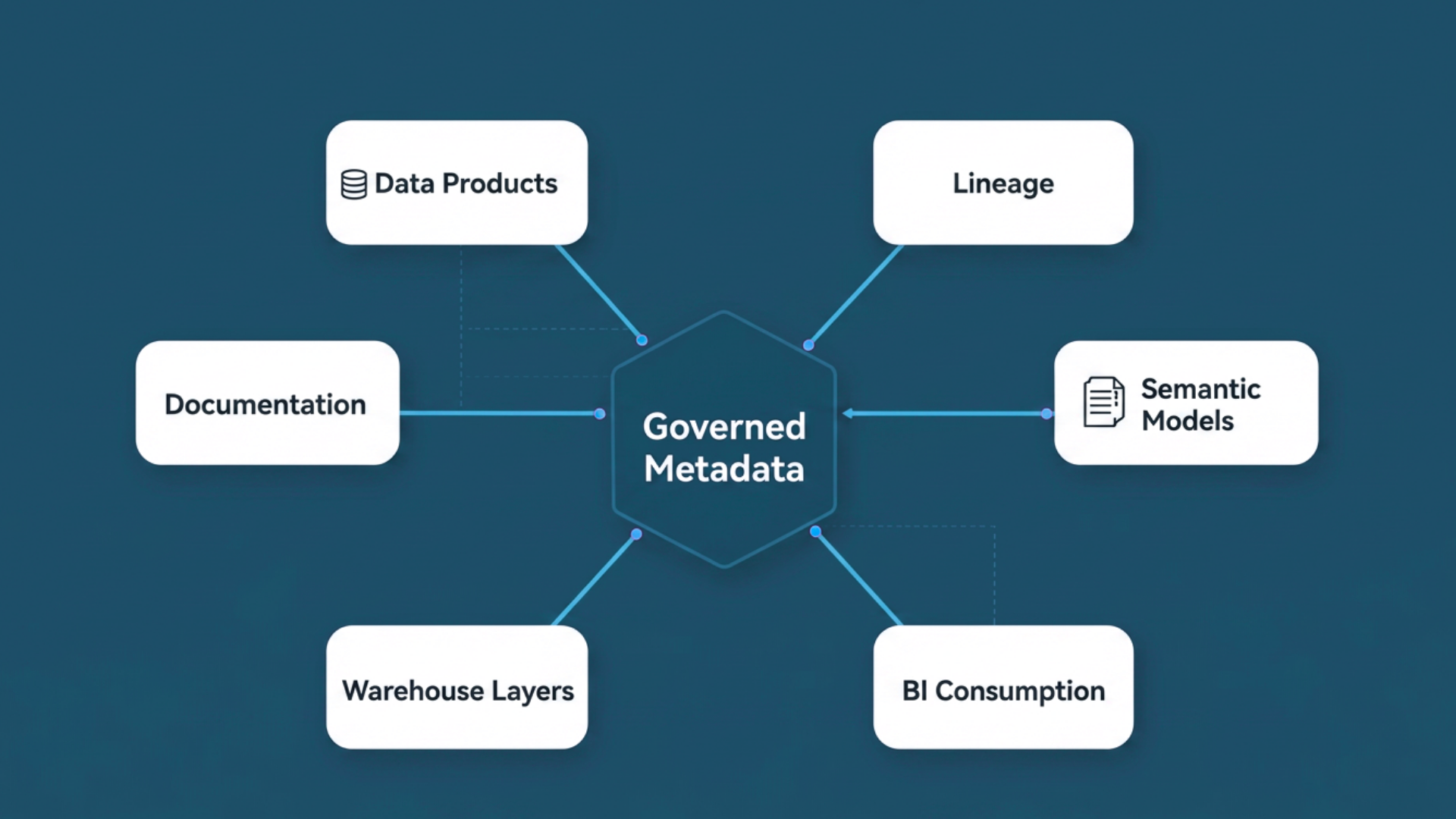


The real challenge in analytics delivery is not producing reports quickly. It is producing analytics in a way that survives change.
Schema shifts, new sources, evolving business definitions and changing reporting needs are normal in modern data environments. When governance is treated only as compliance, it can slow teams down. When it is treated as an engineering discipline, it helps teams deliver with more consistency, traceability and confidence.
Governed data products and semantic models are two of the mechanisms that make analytics delivery more repeatable. They help teams move from isolated reporting outputs to reusable, documented and maintainable analytical assets.

What Is a Governed Data Product?
A governed data product is a data asset designed for consumption with accountability built in.
It has a clear business meaning, an identified owner and transparent dependencies. Its transformations are documented, and changes move through controlled deployment processes rather than ad hoc edits. This structure helps reduce rework, reconciliation and firefighting because teams can understand what an asset means, where it comes from and what may be affected when it changes.
Governance, in this sense, is not a layer added after delivery. It is part of how the data product is designed, maintained and made usable.

What Is a Semantic Model?
A semantic model translates governed data into analytical meaning.
It defines measures, dimensions, relationships and business logic in a way that BI tools and decision-makers can reuse. In Microsoft-oriented environments, Power BI is often the most visible surface for semantic models, but the principle is broader: semantic models help prevent every report from reinventing its own logic.
They act as the bridge between warehouse discipline and business consumption.
Why Should Data Products and Semantic Models Be Designed Together?
When data products and semantic models are designed in isolation, definitions drift.
Revenue is the classic example: gross versus net, booked versus recognised, discounts included or excluded. If those definitions are handled separately across reports, every dashboard can end up telling a different story.
Designed together, governed data products and semantic models help teams standardise definitions and reuse them more consistently across reporting and analytical workflows. That is the difference between fragmented reporting and analytics teams that can trust the numbers they deliver.
Which Governance Mechanisms Matter Most?
The mechanisms that make governed analytics work are practical, not abstract.
Metadata captures definitions, structures and design decisions. Lineage shows how data flows and changes across layers. Documentation makes decisions visible across engineering and BI teams. Impact analysis helps teams understand what may be affected when upstream structures shift. Deployment discipline helps generated artefacts move into target environments in a controlled way.
These are not checkboxes. They are engineering practices that keep analytics delivery repeatable.

How Does Automation Support Governed Analytics Delivery?
Automation strengthens governance by making repeatable practices easier to apply consistently.
Teams define and maintain metadata as the design basis for generation. From that metadata, warehouse structures, orchestration artefacts, documentation and semantic models can be produced. Those assets are then deployed into target environments such as SQL Server, Synapse, Fabric and Power BI, where execution happens.
The value is straightforward: fewer manual steps, fewer inconsistencies and more confidence in delivery.
How Does This Fit Microsoft-Oriented Data Environments?
This approach fits naturally into Microsoft-oriented data environments.
SQL Server and Synapse can provide governed warehouse layers. Azure Data Factory and Microsoft Fabric pipelines support orchestrated data flows, while governed metadata and lineage help teams understand dependencies and change impact. In Fabric contexts, OneLake can provide a governed storage foundation, while Power BI is a common consumption layer for semantic models. Azure DevOps and GitHub bring version control and CI/CD-oriented workflows into the delivery process.
Together, these tools can support a delivery model where dependencies are clearer, deployments are more controlled and collaboration between engineering and BI teams is stronger.
What Pitfalls Should Teams Avoid?
Teams run into trouble when semantic models become shortcuts for individual reports rather than reusable analytical assets. The same happens when data products are created without ownership, when BI definitions are separated from warehouse design, or when automation is introduced without lineage, documentation and review.
Another common trap is the “single source of truth” mantra. It oversimplifies the reality. What matters is not one perfect dataset, but governed, reusable assets that are designed to be consumed consistently across analytical workflows.
Conclusion: Governance Built In
Governed data products and semantic models are not overhead. They help teams deliver analytics that is consistent, maintainable and trusted.
Automation makes the process more repeatable. Microsoft’s ecosystem provides target environments for storage, orchestration, deployment and consumption. AnalyticsCreator enables teams to generate warehouse structures, documentation, orchestration artefacts and semantic models from governed metadata for Microsoft-oriented environments such as SQL Server, Synapse, Fabric and Power BI.
Governance works best when it is built in from the start.