SQL Server 2025: Native AI, Enhanced Security & Deep Fabric Integration
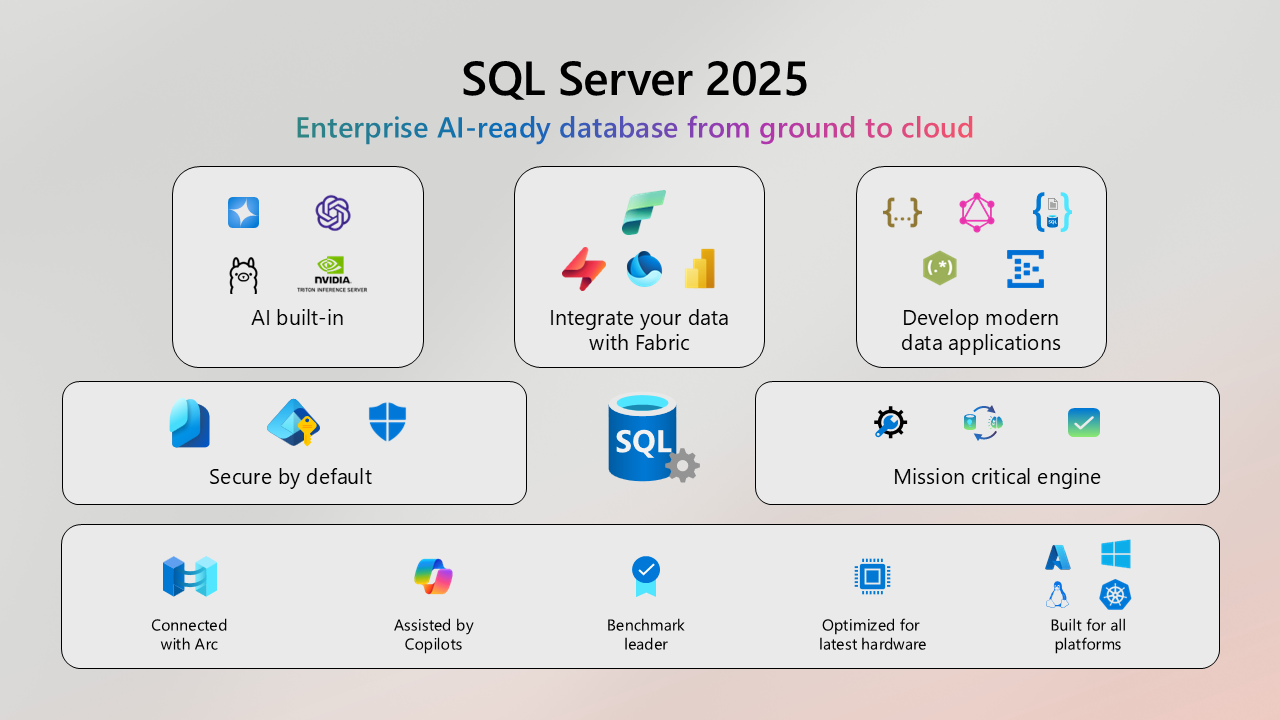
SQL Server 2025: Native AI, Enhanced Security & Deep Fabric Integration
author
Richard Lehnerdt Mar 20, 2025
SQL Server 2025: Native AI, Enhanced Security & Deep Fabric Integration
3:28

Microsoft’s recent announcement of SQL Server 2025 marks a major milestone in modern data management. With built-in AI capabilities, enhanced security, and deep cloud integration, SQL Server 2025 is designed to meet the evolving needs of data-driven enterprises.

Native AI Integration

A defining capability of SQL Server 2025 is its native AI support. The introduction of vector data types and AI model management within the SQL engine allows organizations to build intelligent applications without relying on external systems. This improves the handling of unstructured data and enables modern RAG (retrieval-augmented generation) patterns, streamlining the development of AI-driven solutions.

Enhanced Security Measures

Security is a top priority in SQL Server 2025. With Microsoft Entra managed identities, hard-coded credentials are eliminated, reducing common risk vectors. Zero Trust principles ensure that every access request is authenticated, authorized, and encrypted, strengthening security across the entire data platform.

Performance and Developer-Focused Enhancements

SQL Server 2025 introduces several improvements aimed at increasing performance and developer efficiency:

  • Optimized Locking Mechanisms: Improved concurrency and system throughput for high-volume transactional environments.
  • Native JSON Support: A new JSON data type and JSON indexing simplify semi-structured data handling.
  • Regular Expressions in T-SQL: Enhanced regex capabilities make complex string pattern operations more efficient.

Integration with Azure and Microsoft Fabric

A standout feature of SQL Server 2025 is its deep integration with Azure and Microsoft Fabric. Fabric Database Mirroring enables near-real-time replication of SQL Server transactional data into the OneLake data layer. This minimizes traditional ETL workloads, accelerates data availability, and supports real-time analytics scenarios.

Implications for Data Analytics

For data teams and analytics professionals, SQL Server 2025 delivers transformative benefits:

  • Advanced Data Processing: AI-native capabilities enable sophisticated processing and real-time insights directly within the database.
  • Seamless Data Flow: Deep integration with Microsoft Fabric and Azure ensures fluid, platform-wide data movement.
  • End-to-End Security: Enhanced protections ensure that sensitive data remains secure throughout its lifecycle.

In summary, SQL Server 2025 represents a forward-looking vision for enterprise data management—AI-enabled, security-focused, and cloud-optimized. It provides a strong foundation for organizations aiming to unlock more value from their data in a rapidly evolving, AI-driven landscape.

For a deeper exploration, watch the following presentation:

Frequently Asked Questions

What’s new in SQL Server 2025?

Native AI, vector data types, JSON support, regex in T-SQL, and Fabric integration.

Does SQL Server 2025 support AI natively?

Yes. AI models and vector search are built directly into the SQL engine.

How does SQL Server 2025 improve security?

It eliminates hard-coded credentials, uses Entra managed identities, and applies Zero Trust principles.

What are the benefits of Fabric Database Mirroring?

Near-real-time replication to OneLake, reduced ETL workloads, and faster analytics.

Is SQL Server 2025 suitable for real-time analytics?

Yes. Combined AI, improved performance, and Fabric integration make real-time insights possible.
Related Blogs

Metadata-Driven Lineage in Microsoft Fabric: Automate Compliance and Governance

Metadata-Driven Lineage in Microsoft Fabric: Automate Compliance and Governance
GO TO >

Metadata-Driven Automation in Microsoft Data Warehousing: From Manual Builds to CI/CD

Metadata-Driven Automation in Microsoft Data Warehousing: From Manual Builds to CI/CD
GO TO >

Why Metadata Should Be the Single Source of Truth in Microsoft Data Warehouses

Why Metadata Should Be the Single Source of Truth in Microsoft Data Warehouses
GO TO >

How AnalyticsCreator Automates SCD Type 2 Historization for Dimensional Models

How AnalyticsCreator Automates SCD Type 2 Historization for Dimensional Models
GO TO >

Metadata-Driven Lineage in Microsoft Fabric: Automate Compliance and Governance

Metadata-Driven Lineage in Microsoft Fabric: Automate Compliance and Governance
GO TO >

Metadata-Driven Automation in Microsoft Data Warehousing: From Manual Builds to CI/CD

Metadata-Driven Automation in Microsoft Data Warehousing: From Manual Builds to CI/CD
GO TO >

Why Metadata Should Be the Single Source of Truth in Microsoft Data Warehouses

Why Metadata Should Be the Single Source of Truth in Microsoft Data Warehouses
GO TO >

How AnalyticsCreator Automates SCD Type 2 Historization for Dimensional Models

How AnalyticsCreator Automates SCD Type 2 Historization for Dimensional Models
GO TO >

Metadata-Driven Lineage in Microsoft Fabric: Automate Compliance and Governance

Metadata-Driven Lineage in Microsoft Fabric: Automate Compliance and Governance
GO TO >

Metadata-Driven Automation in Microsoft Data Warehousing: From Manual Builds to CI/CD

Metadata-Driven Automation in Microsoft Data Warehousing: From Manual Builds to CI/CD
GO TO >

Why Metadata Should Be the Single Source of Truth in Microsoft Data Warehouses

Why Metadata Should Be the Single Source of Truth in Microsoft Data Warehouses
GO TO >

How AnalyticsCreator Automates SCD Type 2 Historization for Dimensional Models

How AnalyticsCreator Automates SCD Type 2 Historization for Dimensional Models
GO TO >

Metadata-Driven Lineage in Microsoft Fabric: Automate Compliance and Governance

Metadata-Driven Lineage in Microsoft Fabric: Automate Compliance and Governance
GO TO >

Metadata-Driven Automation in Microsoft Data Warehousing: From Manual Builds to CI/CD

Metadata-Driven Automation in Microsoft Data Warehousing: From Manual Builds to CI/CD
GO TO >

Why Metadata Should Be the Single Source of Truth in Microsoft Data Warehouses

Why Metadata Should Be the Single Source of Truth in Microsoft Data Warehouses
GO TO >

How AnalyticsCreator Automates SCD Type 2 Historization for Dimensional Models

How AnalyticsCreator Automates SCD Type 2 Historization for Dimensional Models
GO TO >

Metadata-Driven Lineage in Microsoft Fabric: Automate Compliance and Governance

Metadata-Driven Lineage in Microsoft Fabric: Automate Compliance and Governance
GO TO >

Metadata-Driven Automation in Microsoft Data Warehousing: From Manual Builds to CI/CD

Metadata-Driven Automation in Microsoft Data Warehousing: From Manual Builds to CI/CD
GO TO >

Why Metadata Should Be the Single Source of Truth in Microsoft Data Warehouses

Why Metadata Should Be the Single Source of Truth in Microsoft Data Warehouses
GO TO >

How AnalyticsCreator Automates SCD Type 2 Historization for Dimensional Models

How AnalyticsCreator Automates SCD Type 2 Historization for Dimensional Models
GO TO >