Back to all Blogs


Microsoft Fabric makes it easier to centralize data, but GenAI makes it harder to get away with inconsistency. The moment you put enterprise data behind a copilot or RAG experience, every gap in freshness, semantics, and governance shows up in the answers. If you want trustworthy outputs, the work starts upstream: engineering data products that are reproducible, explainable, and safe to evolve.
TL;DR – What Makes Data AI-Ready?
AI-ready data in Microsoft Fabric and SQL Server environments requires:
- Automated, standardized pipelines
- Governed and versioned data products
- End-to-end lineage and impact visibility
- Semantic consistency across domains
- CI/CD-enabled deployment discipline
Generative AI does not fix weak data engineering. It exposes it.
Generative AI Raises the Bar for Data Engineering
Generative AI (GenAI) and retrieval-augmented generation (RAG) systems are changing what “good” enterprise data delivery looks like.
It’s no longer enough for pipelines to run or dashboards to refresh. AI systems operate inside business workflows, copilots, and conversational interfaces. That raises expectations across three dimensions:
- Freshness – Data must reflect current operational reality.
- Explainability – Outputs must be traceable and defensible.
- Safety and governance – Sensitive or inconsistent data cannot surface in AI responses.
AI-ready data is not a prompt engineering problem. It is a data product engineering problem.
Industry Priorities Behind AI-Ready Data
Across the industry, modernization efforts consistently focus on:
- Automation of pipelines and transformations
- AI agents that require fresh, contextual enterprise data
- Observability and governance adherence across systems
- Data lineage and semantic layers to reduce inconsistency
- Distributed data strategies that still demand coherent meaning
These are not abstract themes. They are engineering constraints that determine whether AI projects scale or stall.
Microsoft Fabric and SQL Server: Centralized Storage Is Not Enough

Microsoft Fabric (including OneLake) and SQL Server provide centralized storage and compute. But centralized infrastructure does not automatically create consistent semantics.
Without engineered data products, teams often experience:
- Divergent transformation logic across domains
- Metric drift across Power BI and other tools
- Duplicate pipelines solving similar problems
- Limited visibility into lineage and downstream dependencies
Generative AI amplifies these inconsistencies.
This is why data product engineering in Microsoft Fabric becomes essential: curated datasets and semantic models must be treated as governed, reproducible, versioned products.
What Is Data Product Engineering?
Data product engineering means designing and managing curated datasets, transformations, and semantic models as structured, governed products with:
- Standardized modeling patterns
- Automated artifact generation
- Version control and CI/CD
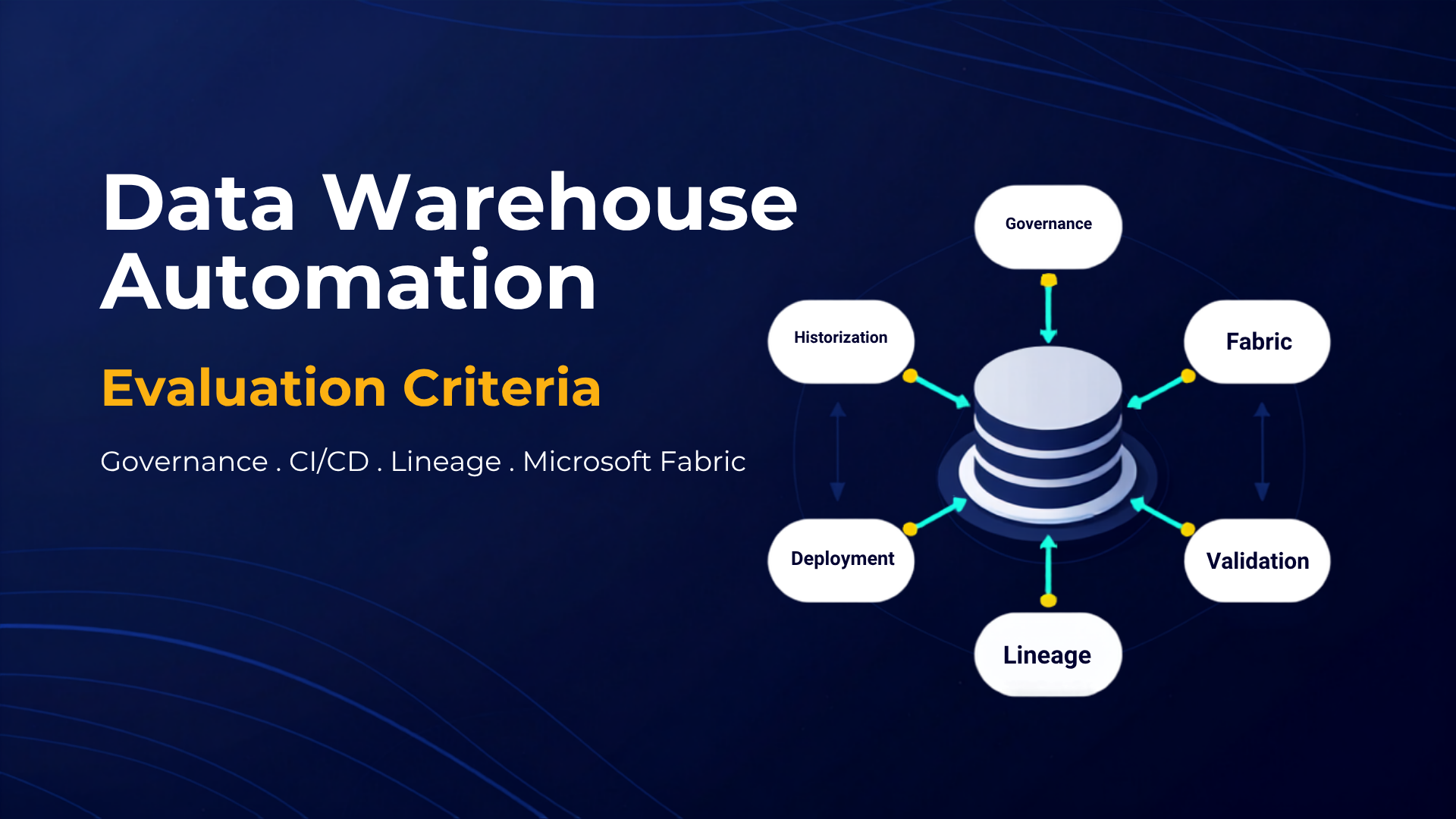
- Built-in lineage and impact analysis
In AI scenarios, these data products become the foundation for RAG pipelines, copilots, and AI-driven analytics.
Looking for an AI-Ready Architecture
AnalyticsCreator acts as a data product engineering automation layer for Microsoft Fabric and SQL Server environments.
It does not replace AI orchestration platforms. Instead, it helps teams keep the data products that power generative AI consistent, governed, and adaptable.
1. Automate Pipeline and Model Generation
Generate ELT artifacts, warehouse structures, orchestration patterns, and semantic models from governed metadata. Reduce manual variation and pipeline drift.
2. Enforce Standards Across Domains
Apply naming conventions, layer structures, historization logic, and reusable transformation patterns consistently across teams.
3. Built-In Lineage and Version Control
Every generated artifact is traceable and deployable through CI/CD workflows. Lineage supports explainability and change impact analysis.
4. Safer Evolution Through Impact Visibility
Before deployment, teams can understand downstream dependencies. This is critical when AI systems depend on stable semantics.
AI-ready data in Microsoft Fabric starts with deterministic automation of pipelines, transformations, semantic models, and deployments.
AI-Ready Data Checklist for Fabric and SQL Server
For each curated dataset feeding analytics or AI applications, ask:
- Is it refreshed through repeatable, controlled execution patterns?
- Can you trace every metric through lineage to its source?
- Are semantic definitions engineered instead of improvised in BI tools?
- Is data exposure governed and access controlled?
- Can the entire data product be reproduced across environments via CI/CD?
If any answer is “no,” generative AI systems will surface the gaps.
Not because prompts are weak, but because the underlying data products are inconsistent.
Start Small, Then Scale Across Teams
AI readiness does not require redesigning everything at once.
Start with one or two high-value data products in Microsoft Fabric or SQL Server. Engineer them with automation, governance, and semantic discipline. Then scale the patterns across additional domains.
Over time, this creates a structured foundation where generative AI initiatives can move faster without increasing operational or compliance risk.
AnalyticsCreator helps data teams industrialize data product delivery in Microsoft Fabric and SQL Server by automating repeatable engineering patterns (pipelines, transformations, and semantic models) and keeping changes traceable and controlled through lineage, versioning, and impact visibility.
AI doesn’t remove the need for disciplined data engineering, it raises the cost of skipping it.