Back to all Blogs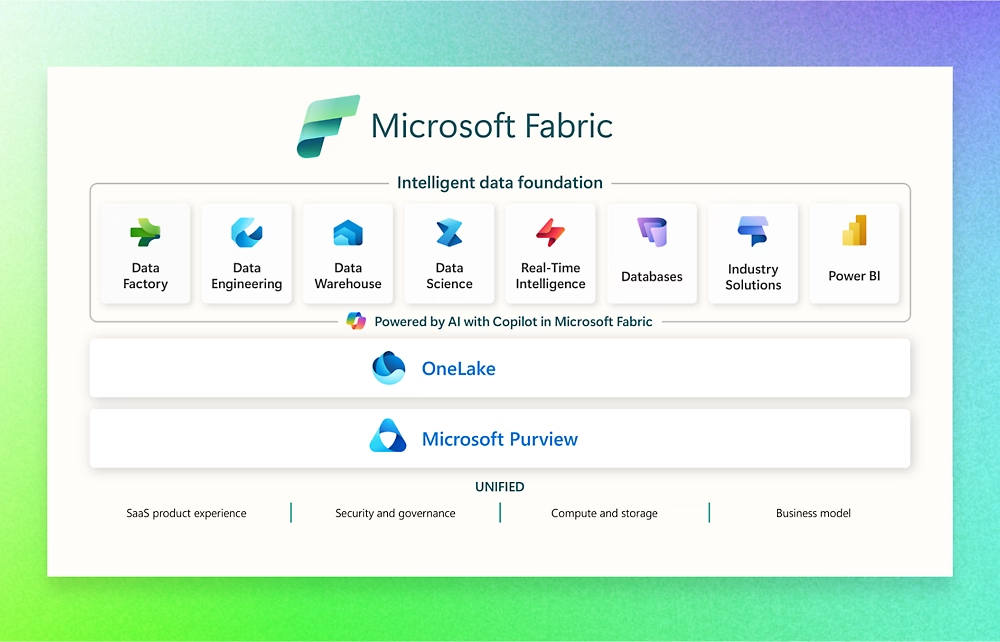


Organizations running SAP systems and modernizing their data landscape often face the challenge of unlocking value from SAP data and integrating it into broader analytics ecosystems. Microsoft Fabric has emerged as a powerful solution, offering purpose-built SAP capabilities that help businesses leverage their enterprise data more effectively.
The Growing Importance of SAP Integration
According to Gartner’s 2025 Data Integration Magic Quadrant, “By 2026, organizations that successfully integrate legacy ERP systems like SAP with cloud-native analytics platforms will achieve 30% higher ROI on data initiatives.” This highlights why SAP integration is now a strategic priority.
Microsoft Fabric, which reached general availability in November 2023, continues to evolve with enhanced SAP connectors and broader module support, as documented in the Fabric Release Notes.
Microsoft Fabric’s SAP Integration Architecture
Fabric provides connectors specifically engineered for SAP systems, understanding SAP’s unique data structures and business logic. Fabric delivers three major advantages:
- Pre-configured SAP connectors: Extract data from SAP ECC, S/4HANA, SAP BW, or OData services with minimal custom development. Benchmarks by Microsoft show a 40% reduction in development time.
- End-to-end data pipelines: Move SAP data through extraction, transformation and enrichment using Fabric’s transformation templates for SAP data structures.
- Unified analytics platform: Once in Fabric, SAP data can power analytics, AI, and BI within a single environment—aligned with IDC’s industry predictions for scalable enterprise analytics.
Real-World SAP Integration Scenarios
- Batch extraction: Large-scale SAP master and transactional data extraction for reporting. Microsoft benchmarks show up to 2 million SAP records processed per hour.
- Delta synchronization: Capture only changed SAP records, supported by new Fabric capabilities using SAP change logs.
- Real-time analytics: Power BI DirectQuery optimizations for SAP enable live dashboards.
- Cross-system enrichment: Combine SAP data with CRM, finance, and operational systems—achieving up to 65% faster reporting cycles as noted in this Microsoft case study.
Azure Data Factory and Fabric Parity
Fabric is rapidly approaching feature parity with Azure Data Factory for SAP connectivity. According to the Microsoft Fabric roadmap, 85% of ADF’s SAP connector features are already available, with full parity targeted for Q3 2025.
A detailed comparison is available in the official connector matrix.
How AnalyticsCreator Enhances SAP-to-Fabric Integration
While Fabric provides strong native capabilities, organizations often benefit from accelerators and governance frameworks. AnalyticsCreator enhances SAP–Fabric integration with specialized automation and modeling tools.
Key AnalyticsCreator Capabilities
- Pre-built SAP data models: Industry templates for SAP modules reduce implementation time by up to 60%.
- Automated metadata extraction: Automatically detect SAP structures and relationships, eliminating manual mapping work.
- Advanced SAP data quality rules: Specialized validation designed for SAP-specific data types and business logic.
Organizations see 30–40% faster time-to-value and significantly reduced integration risk when adopting AnalyticsCreator for SAP-to-Fabric migrations.
Strategic Considerations
- Technology alignment: A 2025 BARC survey found 25% faster value realization for Microsoft ecosystem customers.
- Complex transformations: Fabric’s transformation engine, combined with AnalyticsCreator’s SAP-optimized patterns, accelerates advanced use cases.
- AI readiness: Fabric's unified platform supports AI initiatives involving SAP data, backed by Microsoft’s AI readiness tool.
Implementation Best Practices
The Microsoft Fabric Implementation Guide recommends a phased approach:
- Start with a focused proof of concept
- Document reusable patterns
- Establish governance frameworks
- Plan for scalability from day one
Both the SAP on Microsoft Community and AnalyticsCreator’s partner network provide proven methodologies for SAP–Fabric migrations.
AnalyticsCreator’s Proven Methodology
- Rapid prototypes: Working prototypes delivered in 2–4 weeks.
- Low-code/no-code extensions: Visual designer for SAP model extensions.
- Parallel development tracks: Architecture, pipelines, and analytics delivered simultaneously.
- Dynamic documentation: Continuously updated best-practice documentation.
The Future of SAP Integration in Fabric
According to the Fabric roadmap, upcoming features include:
- Expanded support for S/4HANA Cloud APIs
- Enhanced metadata discovery and documentation
- AI-assisted mapping and transformation
- Prebuilt SAP data models aligned with industry standards
These evolutions align with SAP’s Open Data Framework initiative intended to simplify cloud interoperability.
Getting Started
Organizations can explore AnalyticsCreator’s SAP migration offering here: SAP Data Migration.
To begin your SAP-to-Fabric journey, schedule a session with the AnalyticsCreator SAP integration team.