Back to all Blogs
How Metadata Powers Both Automation and Governance in Microsoft Fabric
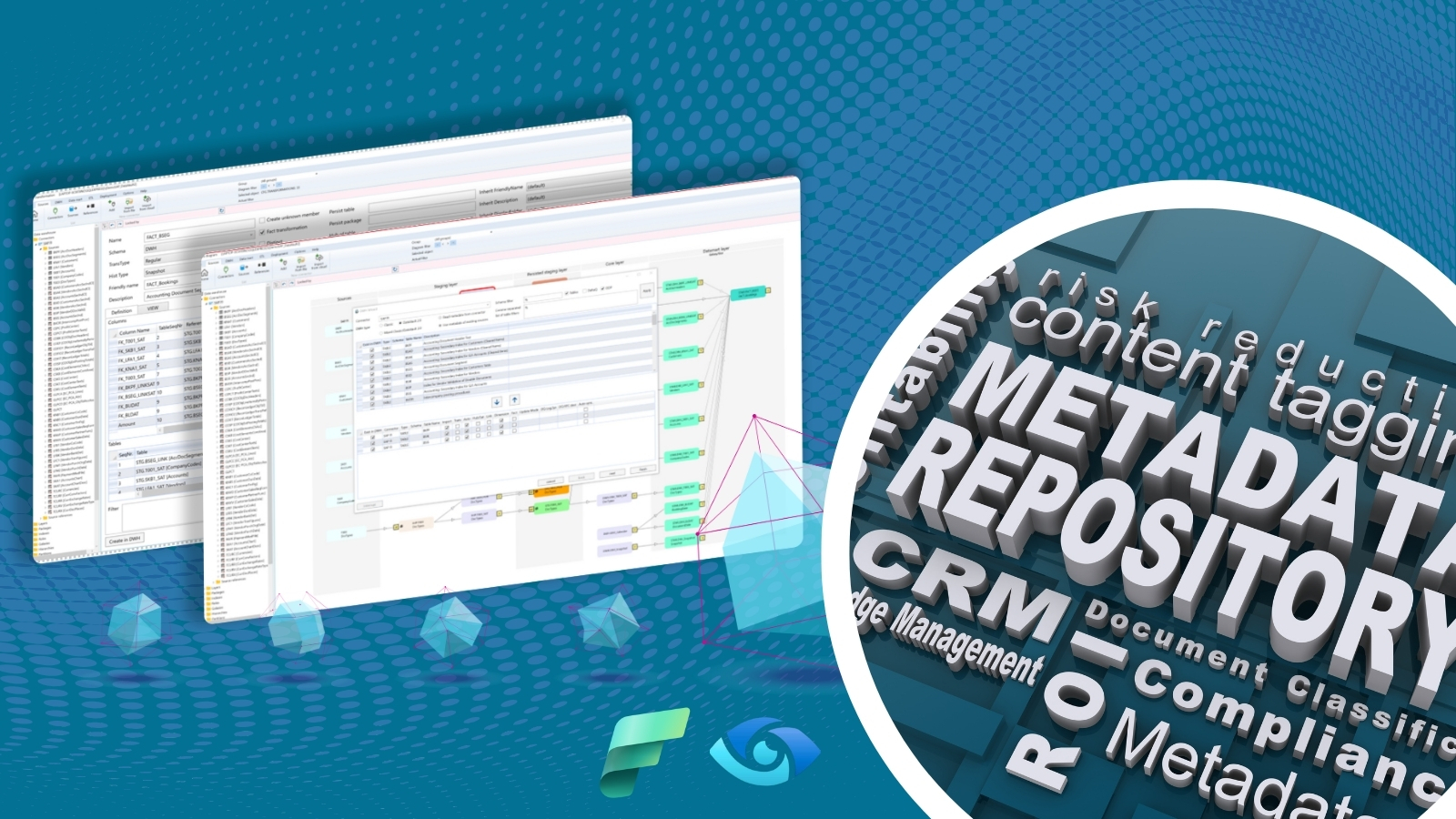


Metadata is now both the input for automation and the anchor for governance. AnalyticsCreator builds with metadata; Microsoft Fabric governs with metadata. Together, they create a seamless flow from automated data product creation to governed analytics consumption.
Metadata as the Driver, Not a Byproduct
In the modern data stack, metadata is no longer just documentation—it defines how systems behave. AnalyticsCreator uses metadata to generate entire data warehouses, while Microsoft Fabric uses metadata to catalog and control access to datasets, reports, and models across OneLake and Power BI.
The Role of Metadata in Automation
With AnalyticsCreator, metadata drives:
- Pipeline generation: Automatically builds ELT pipelines based on metadata, reducing manual effort and enabling rapid onboarding of new sources.
- Data historization: Applies consistent rules across all entities using a metadata-defined pattern—ensuring auditability and compliance.
- Lineage and governance: Maintains live visual lineage from source to semantic model, helping teams trace impacts and track transformations.
- CI/CD alignment: Generates deployable artifacts for Azure DevOps or GitHub pipelines, enabling version-controlled releases.
- Fabric integration: Seamlessly connects metadata-defined logic to Microsoft Fabric, which catalogs and governs the resulting assets (datasets, reports, models).
Metadata-Driven Data Products
AnalyticsCreator treats each data mart as a data product: traceable, governed, and business-ready. Metadata ensures that every product is built consistently, with transparent logic and adaptability to change. In Fabric, these products are discoverable, reusable, and integrated across Power BI, Synapse, and OneLake.
AnalyticsCreator’s Metadata-Driven Approach
AnalyticsCreator defines every stage of the data lifecycle via metadata. It auto-generates:
- SQL-based artifacts and ELT workflows
- Data pipelines for ADF and SSIS
- Semantic models for Power BI, Tableau, and Qlik
- Documentation and lineage diagrams
This metadata model flows directly into Microsoft Fabric, aligning governed lakehouse and warehouse strategies under one architecture—automated and transparent by design.
Conclusion
Metadata isn’t just an audit artifact—it’s a tool for automation and governance. With AnalyticsCreator and Microsoft Fabric, modern data teams can accelerate delivery, enforce consistency, and scale trusted analytics across domains—powered by metadata at every step.
Frequently Asked Questions
How does AnalyticsCreator use metadata?
AnalyticsCreator uses metadata to generate SQL artifacts, ELT pipelines, semantic models, and lineage documentation automatically.
What role does Microsoft Fabric play in governance?
Fabric catalogs workspace assets like datasets and reports, applying security, ownership, and sensitivity labels across the Microsoft data stack.
Can metadata-defined logic be reused in Fabric?
Yes. AnalyticsCreator's metadata output can be reused in Microsoft Fabric, enabling governed deployment and cataloging of semantic models.
Why is metadata no longer just documentation?
Because it drives automation and controls. Metadata defines how systems behave—not just how they’re documented.
How does this improve CI/CD workflows?
Metadata definitions are used to auto-generate deployable code, making it easier to integrate with Azure DevOps or GitHub for versioned releases.
What is a metadata-driven data product?
It’s a data mart or semantic model built from reusable metadata logic—governed, traceable, and ready for business use.
Can this approach support both lakehouse and warehouse strategies?
Yes. AnalyticsCreator’s metadata model generates assets for both SQL and lakehouse environments, unified under Microsoft Fabric.