
AnalyticsCreator evaluation · Step 3 of 5
Control automated BI development
See how AnalyticsCreator provides the governed workflow through which business models, engineering rules, deterministic generators, human expertise and selected AI capabilities can work together across the complete solution lifecycle.
The market has changed
Generating code is becoming easier. Controlling what gets built is not.
AI agents can increasingly generate SQL, schemas, pipelines, semantic models, tests and documentation. This can accelerate individual implementation tasks.
The larger challenge is ensuring that every generated asset represents the approved business model, follows the intended architecture and remains aligned when sources, requirements or technology change.
AI-generated outputs can vary when prompts, models or available context change. Without a maintained design model, later generation may produce technically valid code that no longer preserves earlier business rules, dependencies or architectural decisions.
AnalyticsCreator maintains the approved business and analytical model, engineering rules, transformations and dependencies as governed metadata. Production-ready artefacts are generated from that maintained foundation rather than being recreated independently from isolated prompts.
The AnalyticsCreator approach
Model first. Store the decisions. Then automate the implementation.
Automated BI development should begin with the business and analytical model, not with an instruction to generate code. The approved design must remain available after each generation task has been completed.
Model in AnalyticsCreator
Define business concepts, relationships, target architecture, transformations, historisation and the required analytical structures.
Store the approved design context
Capture mappings, object definitions, engineering rules, dependencies and generation instructions as governed metadata.
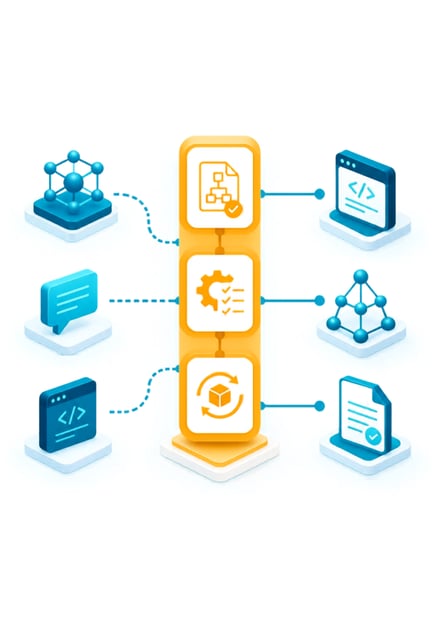
Generate through a controlled workflow
Use deterministic AnalyticsCreator generators and selected AI-assisted capabilities to create production-ready artefacts from the approved model.
Govern change across the lifecycle
Change the maintained design, assess the dependencies and regenerate the affected artefacts from the same governed foundation.
A change to the model can be reflected across dependent database structures, transformations, semantic models, deployment assets, lineage and documentation without asking separate tools or agents to reconstruct the complete context.
Why governance matters
What can happen when AI generates without a maintained model?
The issue is not whether an AI agent can generate code. The issue is whether the generated result remains connected to the approved business meaning, architecture and lifecycle process.
Technically valid, but contextually incomplete
An agent may understand the requested technical task without understanding the complete business meaning or the impact on downstream analytical objects.
Later generation can reinterpret the solution
When requirements change, a new prompt may generate a different structure without preserving the assumptions, rules or dependencies behind the previous implementation.
Decisions become distributed and difficult to govern
Important logic can become scattered across prompts, code, documents and individual experience instead of remaining in one reusable and reviewable design model.
Reliable automation requires business meaning, architecture, engineering rules and dependencies, not only access to source schemas and a technically plausible prompt.
Reliable automation
Use the most dependable method for each engineering task
AnalyticsCreator currently uses deterministic generation for production code and delivery artefacts where repeatability, traceability and reliable regeneration are essential.
Deterministic AnalyticsCreator generation
- Uses governed metadata and explicit generation rules.
- Produces predictable outputs from the approved model.
- Supports controlled regeneration after design changes.
- Maintains dependencies, lineage and documentation.
- Generates native production-ready Microsoft artefacts.
AI capabilities within the workflow
- Can support modelling and engineering where they add value.
- Work from the approved AnalyticsCreator design context.
- Perform clearly defined and specialised tasks.
- Must meet the required quality and governance standards.
- Can be introduced without replacing the maintained model.
AI capabilities are continually evaluated and can be introduced where they provide a dependable improvement. The governed model and lifecycle process remain the stable foundation as the technology evolves.
People and operating model
Use different professional profiles where they create the most value
Data teams contain different professional profiles. Some engineers value detailed implementation and direct control of code. Others want to work closer to architecture, business requirements and solution design.
These perspectives are not in conflict. AnalyticsCreator allows organisations to combine them within one controlled development process.

Business sponsors and BI leaders
Define the required business outcome, governance expectations, investment priorities and delivery model.
Architects, analysts and consultants
Translate business requirements into models, relationships, rules, architecture and a governed analytical solution.
Developers and technical specialists
Define engineering standards, handle exceptional requirements, optimise performance and extend the generated implementation where specialist control is required.
AnalyticsCreator changes the development and delivery process. The decision should therefore involve business sponsors, BI leadership, architects, analysts, consultants and developers.
Microsoft business context
From shared business meaning to controlled implementation
Microsoft Fabric IQ uses ontology to establish a shared business vocabulary through concepts, properties, relationships, rules and bindings to data in OneLake. This provides trusted business context for people, applications and AI agents.
AnalyticsCreator complements this direction by maintaining the design-time engineering metadata required to turn approved business concepts into analytical models, transformations, historisation, semantic models, deployment assets, documentation and production-ready artefacts.
Fabric IQ focuses on shared business meaning within Fabric. AnalyticsCreator provides the governed engineering workflow through which business and analytical designs become a controlled technical implementation.
Evaluation questions
Is your automated development process governed?
Use these questions to determine whether automation and AI are operating within a controlled engineering lifecycle.
- Is the approved business and analytical model retained before production code and delivery artefacts are generated?
- Can people, generators and AI capabilities work from the same definitions, architecture and engineering rules?
- Can you identify the downstream impact of a source, requirement or model change before regenerating artefacts?
- Can deterministic generation be used where repeatability is essential and AI assistance where it produces a dependable improvement?
- Are business sponsors, architects, analysts and developers aligned around one controlled development and lifecycle process?
Decide whether AnalyticsCreator gives your organisation the control layer required to combine human expertise, deterministic generation and future AI capabilities without losing business meaning, engineering consistency or lifecycle control.
