
AnalyticsCreator evaluation · Step 2 of 5
See where your business benefits
See how AnalyticsCreator can optimise consulting and development processes, increase delivery capacity and support stronger margins, recurring services and scalable product offerings.
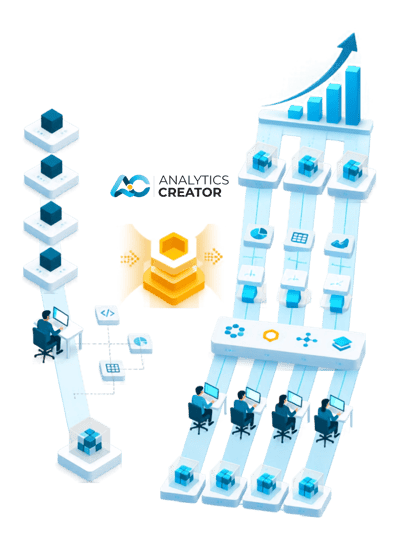

The business outcome
Optimise consulting and development processes
Deterministically generate production-ready pipelines, transformations and delivery assets from governed metadata and design context, without manually implementing each technical component or relying on AI agents to recreate the implementation differently after every change.
Shorten the route to a working result
Move from source metadata to a functioning model and prototype in hours or days, giving stakeholders something concrete to review much earlier.
Increase delivery capacity
Automate structured modelling and implementation work so that one team can cover more of the data and analytics delivery process.
Make specialist knowledge reusable
Capture proven modelling, transformation, historisation and deployment approaches in metadata, wizards, templates and generators.
Improve delivery confidence
Use reproducible processes and governed outputs to estimate, package and deliver projects with greater consistency.
AnalyticsCreator provides a more efficient engineering foundation. The financial outcome depends on how that efficiency is used within the organisation’s pricing, packaging and delivery model.
From efficiency to commercial value
Convert faster delivery into measurable business outcomes
Faster engineering is only the starting point. The commercial value appears when greater delivery efficiency is used to strengthen presales, increase capacity, improve project economics or support recurring and scalable offerings.

Faster prototyping can strengthen presales and customer discussions. Greater delivery efficiency can release specialist capacity and improve project economics. A maintained model can also support recurring services, repeatable product implementations and future customer requirements.
Financial impact
Turn delivery efficiency into commercial value
AnalyticsCreator creates commercial value by reducing manual engineering, shortening delivery cycles, making specialist knowledge reusable and extending the useful life of the governed model.
Retain more of the delivery efficiency
Less manual engineering
Generate repeatable pipelines, transformations and delivery assets from reusable metadata rather than implementing every technical component manually.
Greater potential margin on suitably priced projectsUse specialist time for more valuable work
Faster delivery cycles
Move from model to deployment-ready outputs through one connected workflow with fewer manual handovers and less repetitive implementation.
More projects, broader scope or higher-value servicesReuse one foundation across many customers
Reusable engineering knowledge
Reuse governed models, templates, generators and analytical foundations across multiple product installations or customer environments.
A stronger return as customer volume increasesExtend the commercial life of the model
Visible impact and traceability
Use maintained metadata, lineage and dependencies to support ongoing enhancements, migrations, managed services and future analytical requirements.
Continued value beyond the initial implementationThe actual result depends on project scope, pricing, adoption and delivery execution. For ISVs and platform providers, the commercial multiplier can be greater because the same foundation can be reused across multiple customers.
Selecting the opportunity
Which outcome should AnalyticsCreator help you prove?
A useful evaluation should focus on a specific commercial outcome, not only on whether the product can generate technical assets.
- Could a working prototype improve a current sales, requirements or feasibility discussion?
- Where does limited specialist capacity restrict the number or scope of projects you can deliver?
- Which modelling and engineering knowledge should become reusable across your team?
- Which customer service could be delivered more efficiently or across more organisations?
- Could maintained metadata support ongoing maintenance, enhancement or managed-service revenue?
- Could your software product reuse the same analytical foundation across several customer installations?
- Could specialised templates, connectors, generators or MCP services become billable intellectual property?
- Which existing customer project best represents the commercial outcome you want to scale?
Define whether the priority is faster presales, greater capacity, stronger project margins, recurring revenue or a scalable product offering. The first project should then be selected to test that opportunity.
Explore the commercial detail
Review the business models, packaging approaches and examples
Step 1 introduced the different ways organisations can use AnalyticsCreator. The detailed guide explains how these models can be packaged commercially, where the financial benefits arise and how they can be applied in practice.
Business Models for AnalyticsCreator Partners
Explore consulting, managed services, ISV, SaaS, value-added and partnership models, including packaging approaches and practical examples.
